Spelling without the Friday test: what schools do now
Most schools that dropped the weekly spelling test teach spelling in short, frequent pattern lessons instead. What those lessons involve, how teachers check the words are sticking, and what helps at home.
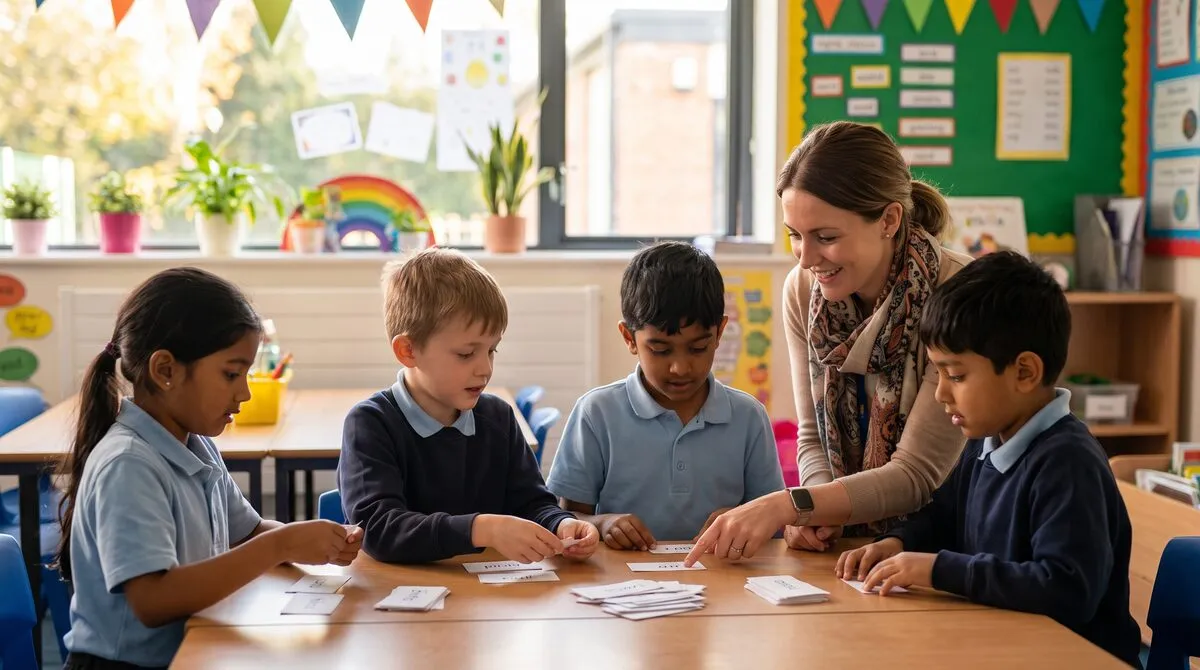
September came and went, and no spelling list came home with it. Nothing to pin to the fridge, no Friday score to ask about. It's easy to read that as the school quietly giving up on spelling. Nearly always, the truth is duller: the school has switched to a way of teaching spelling that simply doesn't produce much to send home.
If you want the background on why the Friday test faded, we cover that in do primary schools still do spelling tests? Below is what your child is likely doing instead, so you can recognise it when it comes home.
If there's no weekly test, how is spelling taught now?
Most schools now teach spelling as pattern study. Children spend short, frequent lessons on a group of words that share a rule, and learn to see what's going on inside them. Why does hopping double the p but hoping doesn't? What do action, station and fiction have in common? Nobody memorises ten unrelated words for a Friday quiz. The aim is for a child to understand a pattern well enough to spell words they've never been given.
Schools usually buy a programme for this, not plan it from scratch. No Nonsense Spelling is one of the most common; Read Write Inc Spelling and Spelling Shed are others. Each has its own style, but underneath they look alike. Sessions are short, they happen several times a week, and most of the time goes on investigating words and returning to patterns taught earlier. A 2023 study in the British Educational Research Journal documented how much classroom practice still varies between schools, so your child's version may not match a cousin's in the next town. The drift across all of them, though, is away from memorise-and-test.
What does a spelling lesson actually look like?
Lessons are short and happen several times a week. Teachers call it "little but often", and the point is that the same patterns keep coming back until they stick. A typical week mixes a few of these:
- Word investigation. Children look at a set of words, and the teacher names the pattern explicitly. Then the class works out together why it holds and tests it on new words. Working it out alongside being told makes the rule stick better than either on its own.
- Word sorts. Sorting words into groups by sound or pattern, for example splitting words where -ough sounds different (through, though, cough).
- Dictation. The teacher reads a sentence aloud and children write it down, spellings and all, so the words get used in real writing from the start.
- "Have a go" sheets and spelling journals. A routine for attempting an unfamiliar word, having a sensible try, then checking, so children build a strategy instead of freezing.
All four build the same habit: when your child meets a word they don't know, they work it out.
Do schools still check spelling at all?
Yes, just not always with a Friday score out of ten. The test's main replacement is your child's own writing. When a word from the spelling lesson starts appearing correctly in a history topic book, it has stuck, and that's the check teachers care about. Plenty of schools still run small quizzes too: low-stakes, tied to the pattern the class has been working on, no surprise lists.
And one formal test remains for everyone. In Year 6, every child sits the statutory spelling assessment as part of the national grammar, punctuation and spelling test: twenty words read aloud in sentences, written into gaps. We explain it in the spelling tests guide. So spelling is still assessed. What's gone is the weekly ritual around it.
Is this really better than the old Friday test?
For most children, the evidence says yes, and the reason is in how memory works. Cramming a list into a few days and testing once tends to produce spellings that fade by half-term. Spreading short bursts of practice across weeks, and tying each word to a pattern and its meaning, produces spelling that lasts and transfers into writing. We've set out the research behind this in the science of spelling.
The Friday test checked whether a child could hold ten words in their head until lunchtime. Pattern teaching wants more. Once a child knows why hopping doubles its p, they can also spell shopping, chatting and swimming, and no one ever had to put those on a list.
What can you do at home?
You can help without playing teacher. Find out what pattern your child is on this week and keep an eye out together for words that fit it. Cereal boxes are good for this, and so are shop signs on the walk home from school. A few minutes of that, a few times a week, does more than a long slog the night before, and you'll be working with the school's approach instead of against it.
Our free spelling resources for parents are organised by year group and built around the same patterns schools teach, so you can reinforce the right thing. SpellCast does this automatically as an app: short, regular practice on your child's year-group patterns, each word read inside a sentence. It's the modern classroom approach, at home, without you having to plan it. You can try it free.
The bottom line
So no, spelling hasn't been dropped. It has moved into short pattern lessons that don't send much home, and into your child's everyday writing, where teachers now look for the proof. The new way is easy to miss because it's quieter, and for most children it works better than the Friday test did.
Sources
- Babcock Education, No Nonsense Spelling Programme (overview of the little-but-often, investigation-based approach). raintree.co.uk (retrieved 24 May 2026).
- Esposito, Capturing variations in how spelling is taught in primary school classrooms in England, British Educational Research Journal, 2023. bera-journals.onlinelibrary.wiley.com (retrieved 24 May 2026).
- Standards and Testing Agency, Key stage 2 English grammar, punctuation and spelling test: information for parents. gov.uk (retrieved 24 May 2026).