Year 1 common exception spelling words
The official Department for Education common exception word list for Year 1 (KS1). These are the high-frequency words children are expected to read and spell by the end of Year 1 — many don't follow standard phonics rules and must be learned by heart.
Free downloadable resources
Your children can practise this whole list — free
SpellCast reads every one of these words aloud and turns them into a hero-adventure game pupils actually want to play, with progress you can see at a glance. The PDF is the handout; SpellCast is the practice. Free forever for your class; families from £2.99/month.
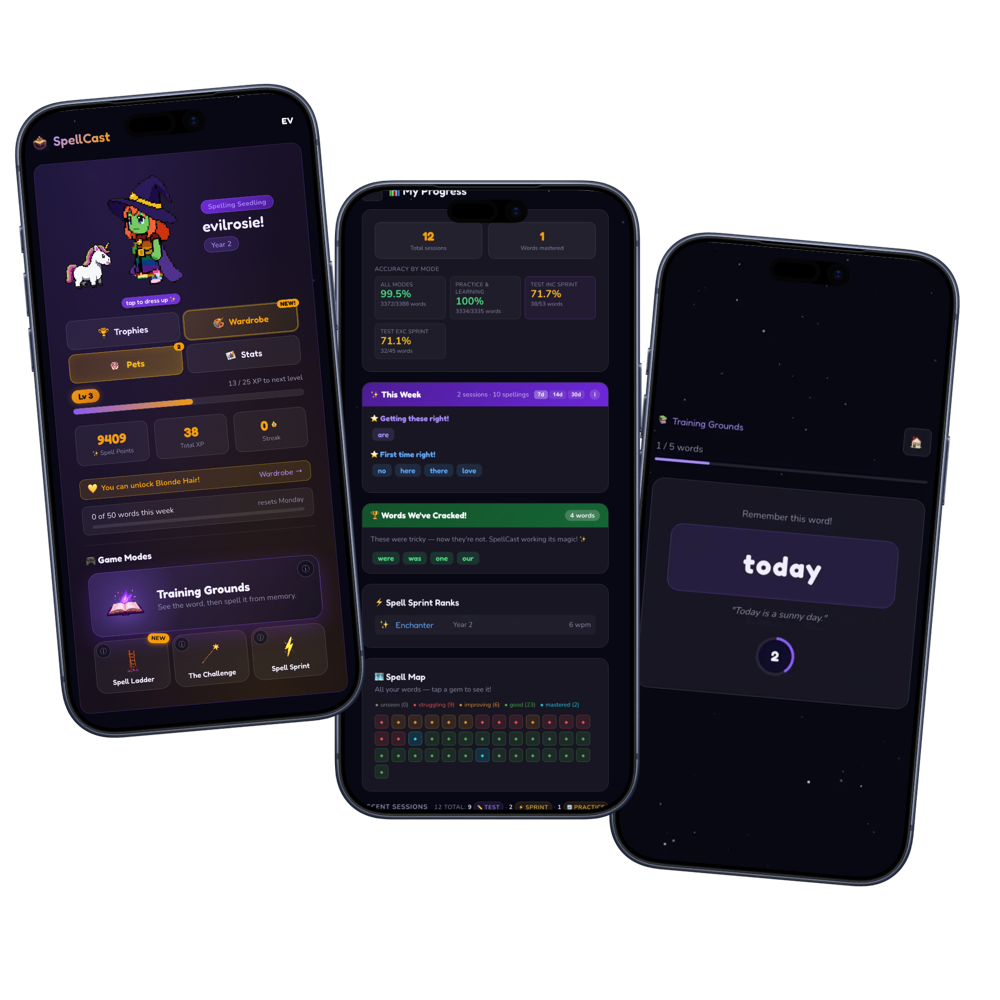
Year 1 common exception words — sometimes called "tricky words" or "sight words" — are high-frequency words that appear constantly in children's reading and writing, but can't be reliably decoded using the phonics patterns taught in Year 1. They need to be recognised on sight and spelled from memory.
The list includes very short, very common words: the, a, is, I, was, are. Most children will encounter all of these words within their first few weeks of reading. Getting them secure early frees up cognitive resource for the harder phonics work to come.
Why these words are "tricky"
Each word on this list breaks at least one phonics rule that Year 1 children have been taught. said has an unexpected vowel sound. once has a soft 'c'. friend has a confusing 'ie'. The rules aren't wrong — they're just insufficient for these particular words. Children need a different strategy: see it, say it, write it, check it.
The most common error pattern is "plausible but phonetically-reasoned misspelling" — a child writing woz for was, or sed for said. These aren't random errors; they show the child is applying phonics logic. The fix is repeated exposure and retrieval practice, not more phonics teaching.
How teachers use this list
- Word walls: many classrooms display all Year 1 and Year 2 common exception words on a permanent wall display — children can refer to them during independent writing.
- Flashcard practice: quick-fire flashcard sessions (5 cards, 2 minutes) build automaticity. The goal is instant recognition with zero hesitation.
- Reading and spelling tests: the KS1 Phonics Screening Check and Year 2 SATs both draw on common exception words. Regular low-stakes testing is the most effective preparation.
- Sent-home lists: many schools send a small batch of common exception words home each week for parents to practise with children. SpellCast's parent-facing spelling feature supports exactly this.
Tips for learning common exception words
- Test, don't re-read. Having a child try to spell the word from memory (then checking) is far more effective than looking at it again. The "testing effect" is one of the most robust findings in memory research.
- Short sessions, often. Five minutes four times a week outperforms thirty minutes once a week. Frequency drives automaticity more than duration.
- Say it in a sentence. Words learned in isolation are harder to access in context. SpellCast reads every word in a complete sentence — the same way teachers dictate in tests.
- Catch the tricky bit. Help children identify exactly what makes the word tricky and draw attention to it. "In
said, the vowel sounds like 'e' but it's written 'ai' — that's the bit to remember."
The full Year 1 list list
| # | Word | Example sentence |
|---|---|---|
| 1 | I | I like to read books. |
| 2 | a | I saw a bird in the tree. |
| 3 | are | We are going swimming. |
| 4 | ask | You can ask the teacher for help. |
| 5 | be | I want to be a teacher. |
| 6 | by | The book is by the window. |
| 7 | come | Come and play with me. |
| 8 | do | What do you want to do today? |
| 9 | friend | My best friend lives next door. |
| 10 | full | The cup is full of juice. |
| 11 | go | Let us go to the playground. |
| 12 | has | She has a new bike. |
| 13 | he | He is my brother. |
| 14 | here | Come here and sit down. |
| 15 | his | That is his coat. |
| 16 | house | We live in a big house. |
| 17 | is | This is my favourite book. |
| 18 | love | I love my family. |
| 19 | me | Please give it to me. |
| 20 | my | This is my favourite toy. |
| 21 | no | No, I do not want any more. |
| 22 | of | I ate all of my lunch. |
| 23 | once | Once upon a time there was a dragon. |
| 24 | one | I have one apple left. |
| 25 | our | This is our classroom. |
| 26 | pull | Pull the rope to ring the bell. |
| 27 | push | Push the door to open it. |
| 28 | put | Put your toys away please. |
| 29 | said | She said hello to me. |
| 30 | says | He says he likes ice cream. |
| 31 | school | I go to school every day. |
| 32 | she | She is very kind. |
| 33 | so | I was so happy to see you. |
| 34 | some | Can I have some water please? |
| 35 | the | The cat sat on the mat. |
| 36 | there | Put your bag over there. |
| 37 | they | They are my best friends. |
| 38 | to | I am going to the park. |
| 39 | today | Today is a sunny day. |
| 40 | was | It was a lovely day. |
| 41 | we | We are going on holiday. |
| 42 | were | They were playing football. |
| 43 | where | Where did you put my shoes? |
| 44 | you | Can you help me please? |
| 45 | your | Is this your pencil? |
Frequently asked questions
Are these the official Year 1 spelling words?
What's the difference between common exception words and tricky words?
How many words should my child practise per week?
Are Year 1 and Year 2 common exception words on the same list?
Can I use this list for free?
Classroom resources for these words
Ready-to-use printables that go with this word list — dictation sentences, word sorts, and pretest/retest pairs.
Related word lists
Related reading
Don't just download — practise
SpellCast turns these statutory lists into a hero-adventure practice game pupils actually want to play. Free forever for your class. Family plan from £2.99/month.