How to Make Spelling Fun for Kids
Spelling practice has a reputation as the dullest ten minutes of the school week, and for a lot of children it really is. Making it fun is not just kinder. A child who enjoys practice does more of it, and regular retrieval is what actually moves spelling along.
Why does making spelling fun matter?
Making spelling fun matters because it determines how often your child practises, and it is repetition across days that builds durable spelling. A child who enjoys practice comes back tomorrow; a child who dreads it avoids it. Research by Karpicke and Roediger (2008) found that repeated retrieval practice produces significantly more long-term learning than re-reading or re-copying the same material.
Variety helps too, though not because children have fixed "learning styles" (an idea the evidence does not support). Each different way of meeting a word is another retrieval attempt, and it is that repeated recall that builds durable memory. We go into the underlying research in our piece on how children actually learn to spell.
Turn this week's words into a game
The quickest win is to take the actual words your child needs to learn (from their school list or the statutory DfE year-group lists) and wrap a game around them. A few that work with almost any list:
- Beat the clock. How many words can they spell correctly in two minutes? Track the score across the week and watch it climb.
- Silly sentences. Take turns: one of you uses a spelling word in the most ridiculous sentence you can invent, and the other has to spell it. The race to out-ridiculous each other means the word gets a lot of attention — and funny, surprising content is genuinely more memorable than neutral content.
- Word ladders. Change one letter at a time to reach a new word at each step, spelling each one aloud: cat → bat → bad → bed.
- Rhyme families. Take a word they can spell and list everything that rhymes and shares the same spelling pattern, so light leads to night, fight, bright. It reinforces the visual pattern, not just the sound.
Keep rounds short and stakes low, so it feels like a game rather than a test in disguise. Five minutes of practice most evenings will do more than a thirty-minute cram the night before test day: the brain builds spelling through repeated small doses, not one big one.
Spelling games for primary school children
Some games are standard in UK primary classrooms (lesson starters or literacy warm-ups) and work just as well at home with two people and no prep.
- Word sorts. Write ten words on slips of paper and ask your child to sort them by spelling pattern: words with a silent letter, words that double the consonant before -ing, words ending in -tion. We have ready-made word sort worksheets for Y1 through Y6 if you want somewhere to start. Sorting forces your child to look closely at how words are built, which is what makes patterns transfer to new words.
- Dictation race. Read a word, your child writes it as fast as they can, then swap: they read one to you. The speed shifts attention away from anxiety, and taking turns keeps both of you invested. Use the KS1 and KS2 statutory word lists as your source so the words match what school expects.
- Countdown letters. Give seven letters and race to find the longest word you can both spell correctly. Like the TV game, but you can bias the letters towards this week's list.
Get them up and making
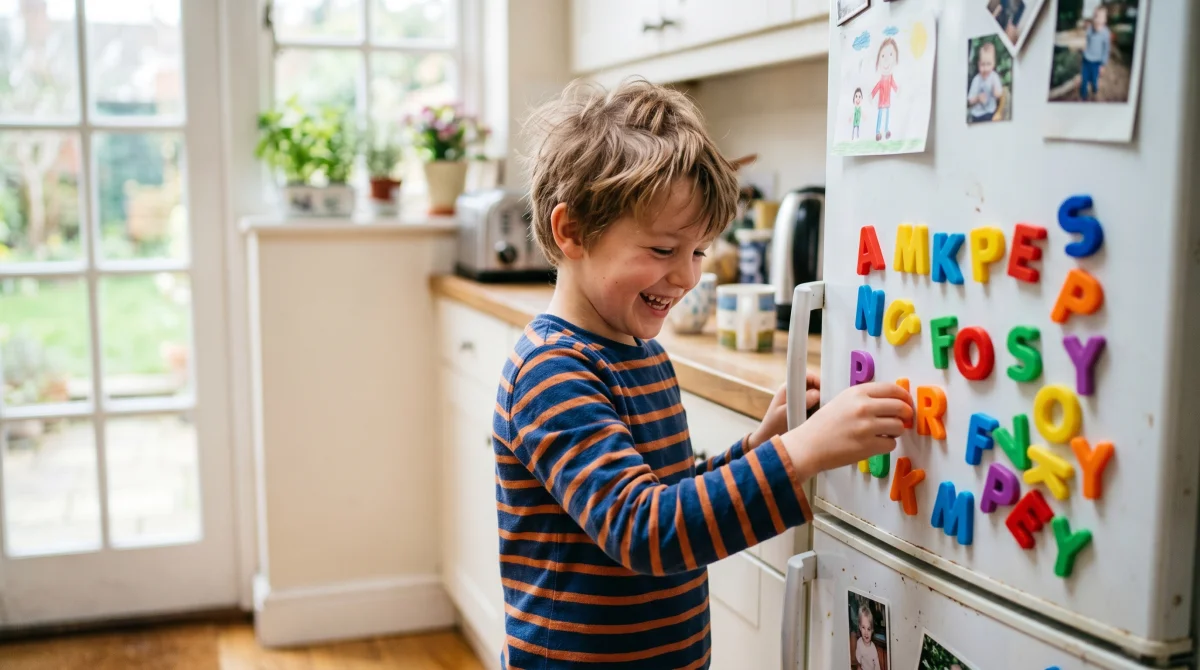
Sitting at a table is only one way to practise, and for a wriggly child it is the least appealing one. Words can just as easily be shouted while bouncing on a trampoline, written in chalk on the patio, built from magnetic letters on the fridge, or shaped in playdough. You can hide words around the house for a spelling scavenger hunt, or ask your child to write the word in the air with a big arm movement before putting it on paper.
The point of mixing it up is not to match a "type of learner". Doing something physical and a bit silly lifts the whole thing out of worksheet mode, and a reluctant child is far more willing to join in.
Use screens, but use them well
Children already see phones and tablets as fun, so a good spelling app borrows that feeling for practice they will happily repeat. The ones that work turn words into a game with rewards and progress, read each word aloud so a child can play independently, and keep sessions short enough to stay enjoyable. Our guide to spelling apps for kids walks through the main options.
SpellCast is a UK spelling app built specifically to make practice feel like play rather than homework. It loads your child's actual statutory year-group words (Reception through Year 6), reads each one aloud in clear British English so children can play independently without an adult dictating, and wraps the whole thing in a hero character that levels up as words are cracked. Sessions are short by design (ten minutes at most), which aligns with what spaced retrieval research suggests works best.
It runs on any phone, tablet or laptop with no app download required. Schools pay a flat annual fee; families can try it free for six weeks with no credit card.
Keep it short, light and shared
A few minutes often beats a long, grudging session, and doing it together beats sending your child off alone. Celebrate effort and funny attempts alongside correct answers, and the moment it tips into a battle, stop and come back later. The goal is not a perfect score tonight; it is a child who does not groan when spelling comes up tomorrow.
If your child has already started to dread it, our free spelling resources for parents include guides on rebuilding motivation alongside the word lists.
The bottom line
Making spelling fun is not a frill: it is what gets a child practising often enough to improve. Wrap a game around the week's words, try some of the primary school games above, get them moving and making, and keep every session short and shared. If you want a screen option that handles the game-making for you, SpellCast is designed exactly for this: statutory words, British-English audio, short sessions, free to try. Enjoyment is what turns spelling practice from something you have to enforce into something your child keeps doing on their own.
Source: Karpicke, J.D. & Roediger, H.L. (2008). The Critical Importance of Retrieval for Learning. Science, 319(5865), 966–968.